

Q1: Why build rabbit traps in Minecraft?
Rabbits serve as a food source (rabbit meat) and material providers (rabbit hide, rabbit’s foot), but due to their fast movement and small size, direct chasing is inefficient. Traps enable automated capture, saving time and improving resource gathering efficiency.
Q2: What basic materials are needed to make traps?
Common materials include:
- Redstone dust (for triggering mechanisms)
- Sticky pistons (to control block movement)
- Pressure plates/Tripwire hooks (as triggers)
- Stone-type blocks (for constructing trap structures)
- Rails and minecarts (suitable for lure-type traps)
Q3: How to choose a location to build the trap?
Prioritize areas where rabbits frequently appear:
- Beside grass in Plains biomes
- Near cactus patches in Deserts
- On exposed ground in Snowy Tundra regions
Q4: Can traps accidentally harm other mobs or players?
Some dangerous traps (like lava traps) may cause indiscriminate damage. It is recommended to set up warning signs or restrict access areas on multiplayer servers.
Q5: How to improve a trap’s concealment?
- Cover the surface with grass blocks and leaves.
- Make pressure plates blend with the surrounding path material.
- Use natural terrain (like slopes, bushes) to disguise the entrance.
Five Practical Trap Design Plans
- Basic Drop Trap
- Principle: Exploits the rabbit’s AI pathfinding behavior to seek food, luring it onto a disguised pit.
- Construction Steps:
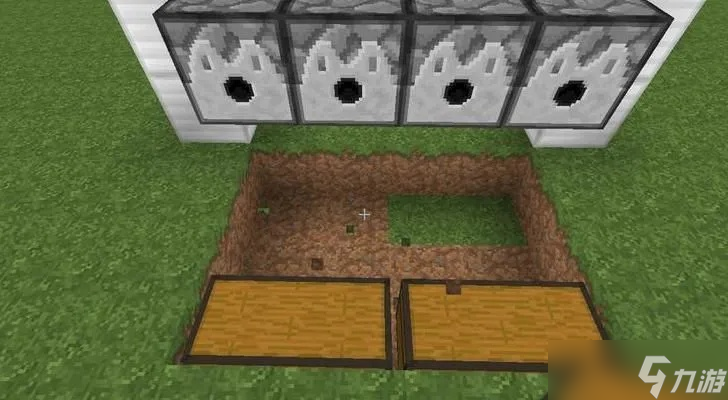
- Dig a 3×3 block pit, 4 blocks deep.
- Place hoppers at the bottom connected to a chest (for automatic loot collection).
- Cover the top with grass blocks and tripwire hooks.
- Plant carrots around as bait.
- Advantage: Low material cost, suitable for early-game construction.
- Redstone Piston Trap
- Core Components: Redstone circuit + Sticky pistons.
- Building Process:
- Select an open area and dig a 凸-shaped pit (leaving a central pillar).
- Install Redstone torches on the pit walls and lay Redstone wiring.
- Deploy sticky pistons at the edges and link them to pressure plates.
- Cover the trap area with blocks matching the ground.
- Technical Point: Ensure the piston signal transmission distance does not exceed 15 blocks; use Redstone repeaters to boost the signal if necessary.
- Lava Threat Trap
- Design Concept: Achieves efficient elimination via lava, paired with a collection system to avoid resource waste.
- Key Steps:
- Build an enclosed hut (place a trapped chest inside).
- Hide a lava pool and piston-controlled mechanism in the roof.
- Set up a dual Redstone circuit (to prevent failure from a single fault).
- Install an iron door at the exit paired with a Redstone locking system.
- Note: Control lava flow speed using blocks to prevent overflow and structural damage.
- Minecart Capture Device
- Unique Design: Combines rails and activator rails for live capture.
- Setup Method:
- Lay a loop of powered rails to maintain movement.
- Place carrots beside the track to attract rabbits into the minecart.
- Set up a collection point and use a name tag at the terminal to prevent despawning.
- Camouflaged Hay Bale Trap
- Inspiration Source: Natural camouflage solutions from real-world practices.
- Innovations:
- Uses shovels to stack hay bales for visual deception.
- Places a water layer inside the pit to cushion falls (suitable for scenarios requiring live capture).
- Exploits leaf block hitbox properties to create a floating illusion.
Advanced Optimization Techniques
- Signal Enhancement: Place Redstone repeaters every 14 blocks in long-distance Redstone circuits.
- Mob Filtering Mechanism: Achieve rabbit-specific capture through openings of different heights.
- Anti-Escape Design:
- Use ice blocks for pit walls to reduce climbing possibility.
- Set trapdoors at the entrance as a secondary safety measure.
- Automation Improvements:
- Connect a comparator for a “chest full” alarm.
- Pair with a daylightsensor to enable day/night mode switching.
Safety Precautions
- Build fire-resistant walls around lava traps.
- Clearly mark dangerous areas in multiplayer survival mode.
- Regularly check Redstone circuits to prevent natural decay from causing failure.
Version Compatibility Note
The schemes described in this article are suitable for:
- Java Edition 1.16+ (compatible with Redstone mechanics)
- Bedrock Edition 1.20+ (may require slight adjustments to component placement rules)
By reasonably applying the above plans, players can establish efficient rabbit farms in Minecraft. Choose between basic or advanced trap types based on actual needs to balance resource investment and output efficiency.


